Let’s take a look at the most common, soul-crushing bullet point found on 90% of generic resume templates across the internet:
- “Responsible for managing the database and helping the team with code deployments.”
To a human, this sentence is boring. To an Applicant Tracking System (ATS), this sentence is practically invisible.
The words “Responsible for,” “Managed,” and “Helping” are considered “Stop Words” in Natural Language Processing (NLP). Because every single applicant on earth uses them, the algorithm assigns them a semantic weight of near-zero.
If you want to trigger the advanced parsing algorithms inside Workday and Eightfold.ai, you have to stop writing like an entry-level intern and start writing like an executive operator.
Here is the unvarnished truth about how ATS engines score action verbs, and the high-impact vocabulary you need to inject into your resume format today.
How Algorithms Score Vocabulary (The TF-IDF Model)
Many enterprise hiring platforms use a mathematical model called TF-IDF (Term Frequency-Inverse Document Frequency) to rank candidate resumes.
In simple terms:
- Term Frequency: How often does a word appear in your resume?
- Inverse Document Frequency: How rare is this word across the millions of other resumes in the database?
If you use the word “Assisted,” the algorithm sees that 99% of other resumes also use “Assisted.” Therefore, the word is mathematically penalized and deemed worthless. It does not differentiate you.
However, if you use the word “Orchestrated” or “Architected,” the algorithm notices that only the top 5% of resumes utilize these terms in proximity to technical hard skills. Your semantic match score skyrockets.
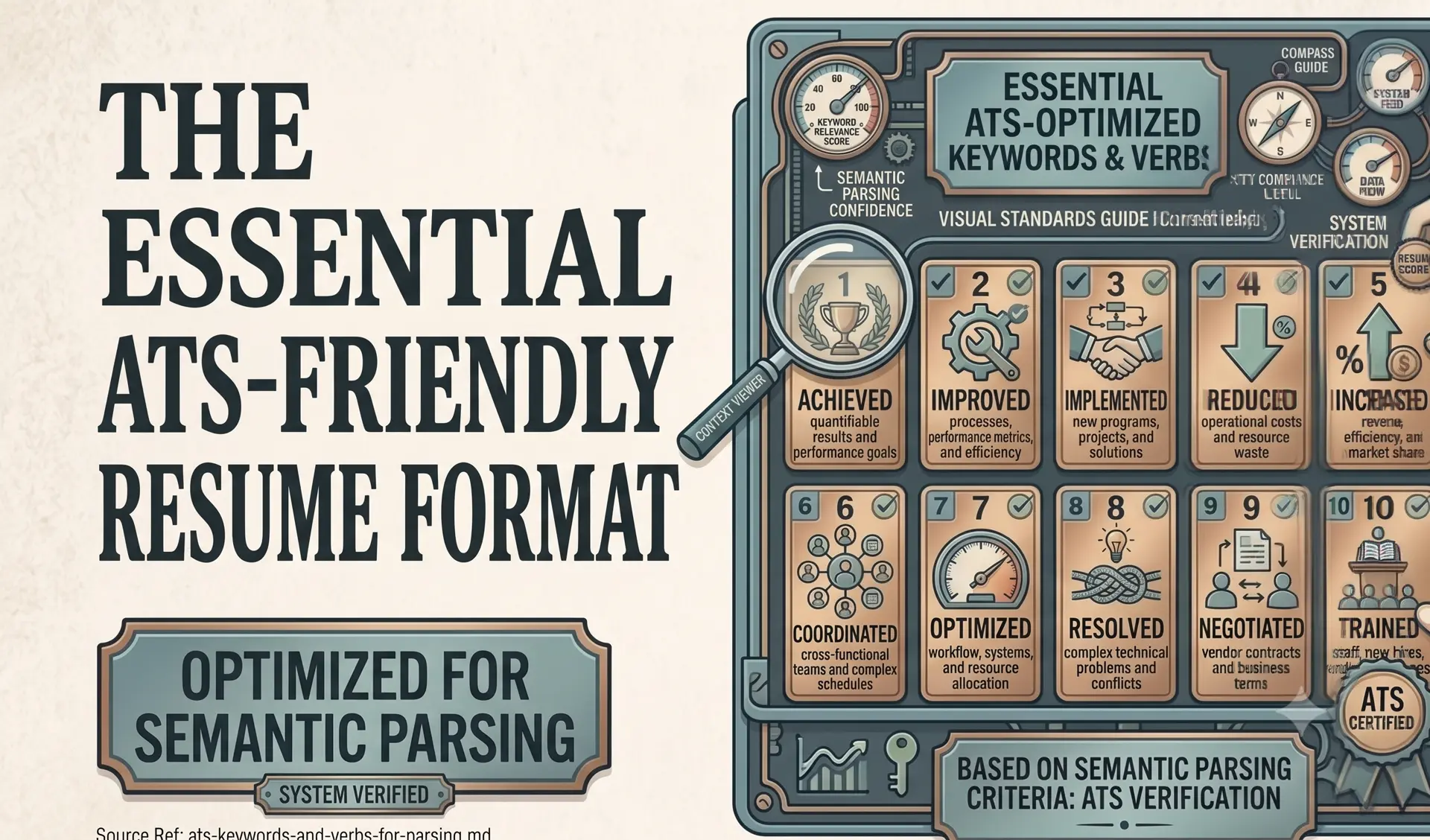
The Power Verb Arsenal
Stop using weak, passive verbs. Open up your resume maker and aggressively swap out the left column for the right column.
1. Instead of “Managed” or “Led”
“Managed” implies you just sat in a chair and watched people work. You want words that imply direction and impact.
- Spearheaded: “Spearheaded the migration to AWS…”
- Orchestrated: “Orchestrated a cross-functional team of 12…”
- Directed: “Directed the Q3 go-to-market strategy…”
- Mobilized: “Mobilized offshore engineering resources to…”
- Pioneered: “Pioneered a new agile workflow that…”
2. Instead of “Improved” or “Increased”
“Improved” is vague. Algorithms want to see optimization, scale, and velocity.
- Maximized: “Maximized quarterly ROI by 32% through…”
- Accelerated: “Accelerated CI/CD deployment times by…”
- Optimized: “Optimized PostgreSQL database queries…”
- Scaled: “Scaled the user acquisition pipeline to…”
- Amplified: “Amplified brand engagement metrics by…”
3. Instead of “Created” or “Built”
If you build things, you need to sound like an architect, not an assembly line worker.
- Architected: “Architected a distributed microservices backend…”
- Engineered: “Engineered a highly available load-balancing…”
- Conceptualized: “Conceptualized a new user onboarding flow…”
- Deployed: “Deployed 40+ containerized applications…”
- Forged: “Forged strategic vendor partnerships…”
4. Instead of “Fixed” or “Solved”
“Fixed” sounds like you applied duct tape to a leak. You want to sound like a structural problem-solver.
- Remediated: “Remediated critical tier-1 security vulnerabilities…”
- Reconciled: “Reconciled $4.2M in annual ledger discrepancies…”
- Overhauled: “Overhauled legacy legacy codebases, reducing…”
- Mitigated: “Mitigated Q4 supply chain risks by…”
- Revitalized: “Revitalized a stagnant product line resulting in…”
The “Verb + Metric” Equation
A power verb alone isn’t enough. To achieve a 100% ATS score, you must pair the power verb with a hard skill and a quantifiable metric.
Weak: Helped the team make the website faster. (Score: 0/10)
Strong: Engineered React.js rendering pipelines, accelerating page load speeds by 40%. (Score: 10/10)
The Final Step
Do not let weak vocabulary trap you in the ATS black hole. Grab your current resume, identify every bullet point that starts with “Responsible for,” and delete it.
Run your text through our free, single-column resume builder to lock your new power verbs into a machine-readable resume format. You can also browse our Master ATS Guide to learn exactly how to construct the perfect bullet point, or read our guide on writing the perfect cover letter template to seal the deal with human recruiters.
Stop formatting. Start applying.
We built CleanATS to force your resume into the exact layout modern hiring parsers demand. It completely handles the margins, the typography, and the structural hierarchy for you.